
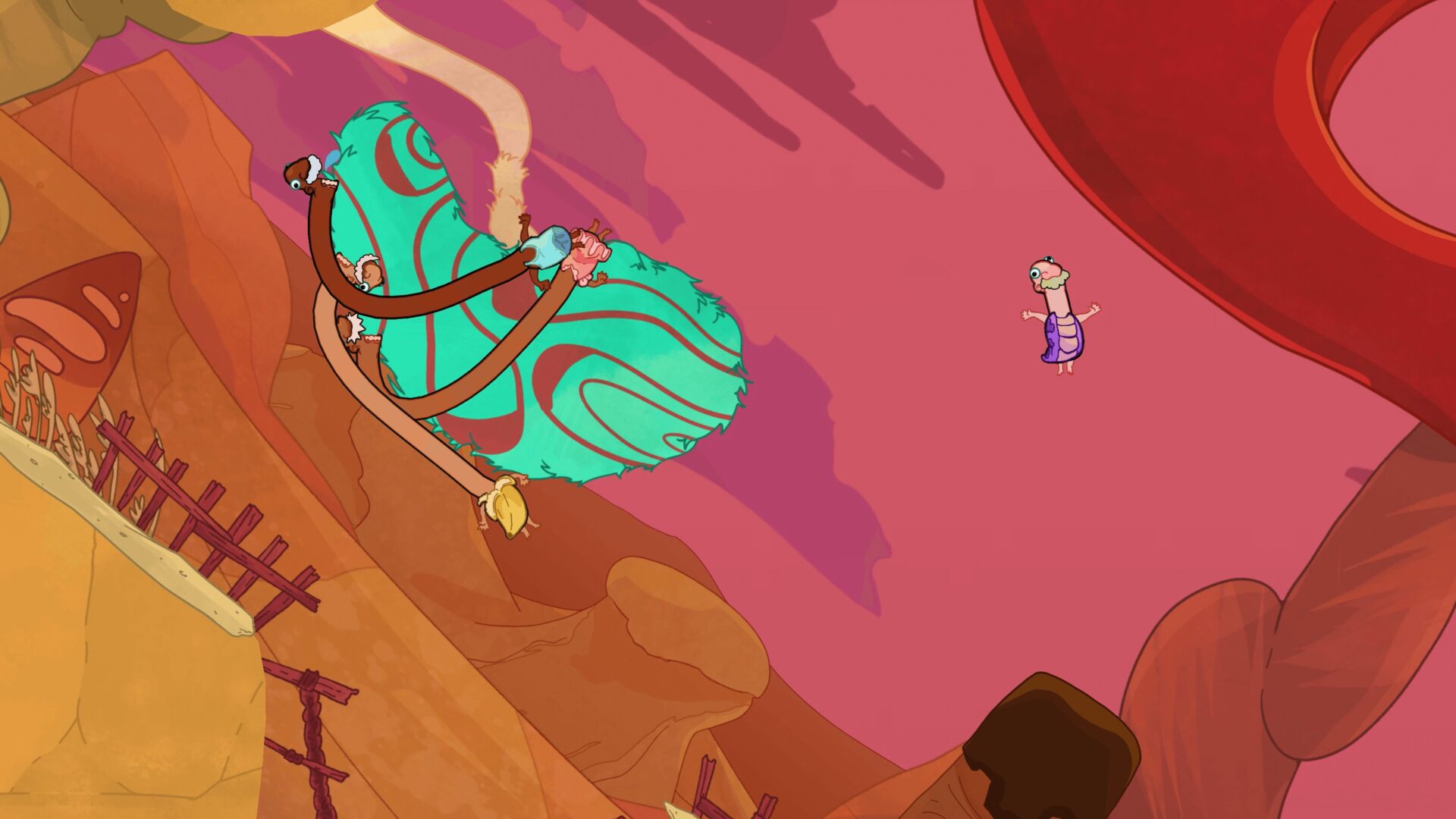
It was nearly 10 years ago now that Peyton Blake found himself scribbling pictures in a small classroom in the Appalachian region of West Virginia. The drawings were of his teachers, usually older men with beards who had been with the school for decades. Blake’s drawings had one weird quirk. All of the teachers he sketched had weirdly elongated necks.
«I was drawing these weird depictions of my teachers,» Blake said with a laugh. «I was a good student and they liked me, so they appreciated it. It all started here, with these drawings.»
Years later, Blake was studying game design at a university in Toronto and his class project required coming up with a pitch. An idea had been building up in his head for what felt like a lifetime—an idea that revolved around weird old men with long and wobbly necks.
That idea eventually turned into Esophaguys.
«It’s been building up in my mind for a long time,» Blake said. «It’s the culmination of a lifetime of playing games. I put all these little ideas aside whenever I played certain games, and I finally had a chance to express them.»
The Esophaguys team is made up of Blake, who serves as the main Game Designer, as well as Tech Lead Hendrik du Toi, Game Designer Matthew Burchat, and Artist Adrian Cogswell. The team has been working on Esophaguys on and off for years, through college graduations, layoffs at other jobs, and in between side gigs. Blake, for example, also works as a carpenter and a brewer.
Navigating with the neck
Esophaguys is a party platformer where players control a forgotten race of people by using their necks—as bridges, grappling hooks, cranes, and various other useful objects necessary to navigate the landscape’s cliffs, tall trees, and other hard-to-reach areas.
It’s a wacky and wondrous combination of platforming, cooperative gameplay, and other entertaining mechanics that flesh out Esophaguys‘ different game modes. There’s the primary cooperative mode where 2 – 4 players work in tandem to navigate difficult terrain, a competitive mode where players go head-to-head in a variety of minigames like soccer, and a story mode that explores the origins and history of the Esophaguys.
When describing the inspirations behind Esophaguys, Blake jumped straight to some of the highlights from his childhood of gaming. The party-game inspiration came from Castle Crashers, a chaotic cooperative platformer developed by San Diego-based studio The Behemoth. Released in 2008, fans still laud Castle Crashers as one of the best cooperative experiences of all time. The kookiness of the characters and story, meanwhile, were inspired by Blake’s love of Oddworld, a series about corporate greed and the run-of-the-mill aliens that fight against it.
«I wanted to do something that combined those two things, couch co-op and the message of something like Oddworld,» Blake said. «The Esophaguys are really relatable. They aren’t heroes, they aren’t your typical protagonists. Hopefully players grow an attachment to them as they play.»
Necks and noise
You can’t have necks without mouths. The soundtrack and audio in Esophaguys is just as unique as the initial concept.
You’ll hear two distinct types of sounds while playing. The first is made up of over 4,000 different mouth-noises that Blake himself recorded over the course of development. We’re talking moans, groans, and grunts, all coming out of the Esophaguys’ mouths as they strain their poor necks.
The second type of sound you’ll hear is music created with the jaw harp, a lamellophone instrument that makes sound via a thin vibrating plate. It can be heard in traditional music from all over the world and in songs like «Join Together» by The Who. Blake believes that this is the first game to make major use of the jaw harp. Esophaguys incorporates music from the instrument—alongside the mouth noises—throughout the entire game.
Together, it makes for audio unlike anything else in gaming.
More than apples and bridges
As mentioned, Esophaguys‘ story mode takes a page out of Oddworld‘s book. The mode has players explore the history of the Esophaguys, a people who once lived alongside humans and helped them with important tasks like picking apples and crossing rivers. Eventually, the usefulness of the Esophaguys came to an end as technology advanced. Humans used apple pickers and metal bridges instead of bearded men with long necks.
«They lost all the respect and all the people that cared about them,» Blake said. «They became these obsolete nonfunctional things. They isolated themselves. The goal for the player is to reunite the Esophaguys and prove to the world that they do have worth.»
The parallels to the real world are obvious—but I wondered where the Esophaguys’ signature long necks came from. Did they evolve to become giraffe-like? Did they come from another planet? Did someone stretch them out?
«I don’t have a good answer for the long necks,» Blake said with a giggle. «The sketches from high school were the key, and I just never put a game mechanic to them. I kept thinking, how can I put this into the game? Then it just kind of clicked with how it would work with the controller.»
Just like players will use the Esophaguys’ necks as a tool to work with—or against—their friends to play soccer and navigate harsh conditions, Blake and his team of developers used the Esophaguys concept as a vehicle to get a game published. They’ve worked on the game for a decade now, and seeing the finish line draw closer every day elicits a feeling like no other.
«I’ve always dreamed of releasing a real game that everyone can pick up around the world,» Blake said. «It’s a rollercoaster of emotion, but a dream come true.»
Wishlist Esophaguys on the Epic Games Store today!
Epic Games Store News