
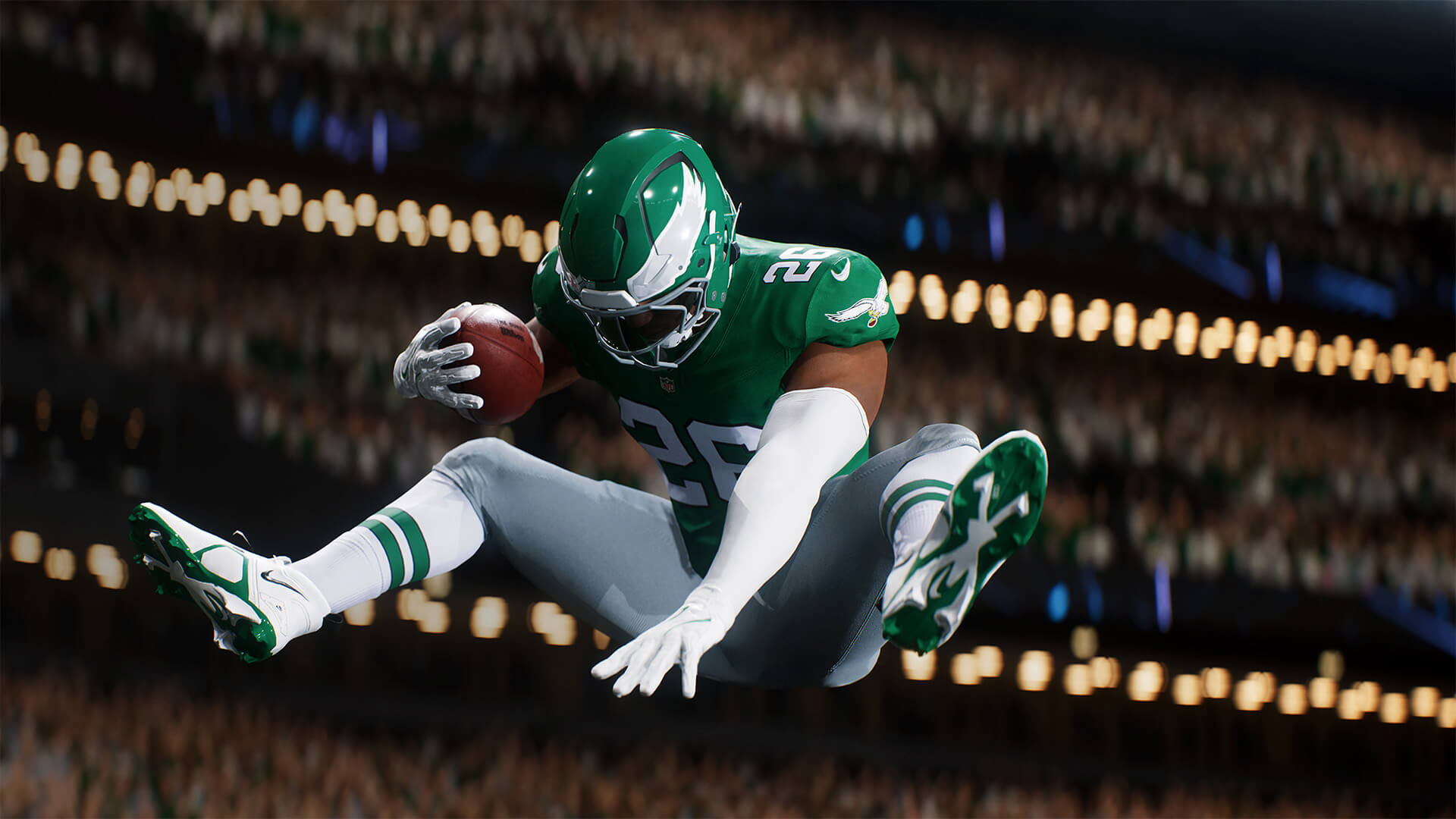
If there’s a third certainty in life beyond death and taxes, it’s that we will see a new annual entry in Madden NFL, the long-running football sim series from EA. It’s an intricate yearly dance, adding new features and refining existing ones, but with a firm deadline for when the latest iteration needs to get in the hands of eager players. The question is always the same: What is the most you can do, and still have it game day ready?
We flew down to EA Orlando to find out. After a full day of talking to the team and some hands-on gameplay, the answer this year is a lot. Between a massive playbook expansion, players and coaches behaving more like their real-world counterparts, and the largest update to Franchise mode in a decade, EA Sports Madden NFL 26 is taking deep shots, and they look poised to hit.
You play to win the game
Clint Oldenburg is the American Football Production director at EA Orlando. A former NFL player in his own right, he has his hands in all aspects of Madden, but takes particular care in making sure the on-field action is as authentic as possible. He was kind enough to sit down with us during our hands-on session to answer questions and give us insight into all the changes we were seeing.
Madden NFL 26 takes aim at some of the biggest hot buttons from the community. Pass coverage is one of the top items on the list, as the team works to strike the balance between making defenders smart enough to put up a fight against the offense, but not overtune them to the point they become clairvoyant, making impossible plays on the ball.
This year the defenders adopt a logical «see the ball/play the ball» approach. Simply put, players need to be able to actually put eyes on the ball in order to intercept it, just like they would in real life. Sure, they can still stick an arm out to try and break up a pass, but higher level players like Sauce Gardner will have the awareness to get their head around when it matters.
Defenders also get a new tool in the form of Custom Zones, an answer to the Custom Route Stems that wide receivers began running last year. As Oldenburg describes it, “This gives you more control at the line of scrimmage to either bring your zones up or deepen zones to your liking. It’s literally a direct counter to Custom Route Stems.”
Custom Zones follow the same principles as their counterparts on offense—you select a defender and set the depth of their zone presnap, ideally right in the path of an incoming route. Combine that with a new option to commit your defenders to in- or out-breaking routes, and there are some subtle but powerful new moves you can make on the chessboard that is the football field.
Football is won and lost in the trenches, and that’s another area that’s getting a lot of attention. Offensive line blocking has gotten a major facelift. New pass block targeting logic should get people blocking the right defenders, though there’s still a difference between your rookie tackle knowing he needs to block Myles Garrett and actually getting the job done. At least now you can give him help by sliding protection left or right with a flick of the right stick. You can even un-target a defender if you want to gamble on letting someone run free, and run blockers can now change targets on the fly, which should be a nice boost to run-oriented attacks.
Defensive lineman and linebackers do a better job with their run fits, and now they can steer blockers once engaged, which has a lot of applications. “If you want to push a dude into the backfield and be disruptive, that would be number one,” Oldenburg explains. “Number two, let’s say you are a linebacker running over the top to get an outside toss, and the guard intercepts your path—you are going to keep your momentum and still make progress towards the ball carrier while he’s blocking you.”
Plenty of other subtle but important changes round out the on-the-field mix. Gamespeed has been retuned across the board, and the action is noticeably faster and smoother than before. You can also call for player substitutions at the line of scrimmage, which will be a big help now that the player Wear and Tear system from EA’s revived College Football series is being integrated in Madden. And positions have been tweaked to reflect their role and usage now, with a clearly designated Mike/Sam/Will, 3-technique, and yes, even Long Snapper positions.
Signature authenticity
Madden NFL has always been about creating the most authentic 11-on-11 football possible. That push continues this year, and it starts with the coaches. EA pulled in decades of data from providers like PFF and Next Gen Stats in order to make facing off against someone like Andy Reid as authentic as possible.
“We are using play call tendency data from every coach,» says Oldenburg. “Over the last four years in Kansas City, if the score was within 6 – 10 points, and it’s 3rd and 4, and it’s plus territory, this is what this guy is normally going to call. And we’re running it for all 32 teams.”
Getting the coaches right means getting the playbooks right. Over 1,000 new plays have been added for Madden NFL 26, a reflection of what Oldenburg describes as an explosion in Shifts and Motion. And it’s not just passes. “In a league where 80-90% of plays were passing plays, now the run game has come back, and you are seeing concepts like Bash, Counter Read, Power Read, and things like that.”
One of the most surprising new additions is Coach Speak. This replaces Ask Madden as your go-to for play recommendations. Using the gathered real-world data, Coach Speak makes recommendations based on what a specific coach would statistically do in a given situation. It also tells you exactly why it chose that play, and it does so with generated text in the style of that coach. If you’re playing as the Lions, get ready for some aggressive play-calling on 4th down, and Steeler fans should be ready for the recommendations to come wrapped in some proper Mike Tomlinisms.
The other side of the authenticity coin is the players themselves. Player behavior has also been significantly reworked to make them behave just like the real-world people they’re based on. Quarterbacks are the big focus. There are new animations, throwing styles, and signature behaviors like Kyler Murray’s low-handed scrambles. The way QBs move in the pocket has changed too. They can now use jukes and other evasion maneuvers with a simple flick of the right stick.
Lastly, the Traits system is massively overhauled, with 50 new Traits dictating everything from when a quarterback tries to escape pressure, to how aggressive they are trying to fit balls into tight windows, to when they will try to scramble. If you are playing Josh Allen you’d best be ready for him to lower his shoulder, and go through your DB for a first down, just like the real thing.
Franchise focus
According to EA, Madden NFL 26 brings with it the largest update to Franchise mode in 10 years. The team’s goal is simple: make every week and every game different. That’s best exemplified in the weekly gameplanning. Every week you’ll have a chance to make tweaks to prepare for your upcoming opponent.
Playsheets are an all new wrinkle meant to do just that. These are addendums to your existing playbook, adding extra options on offense and defense. Want to air it out against a suspect secondary? Install a playbook with some deep passes, or maybe add a playsheet of blitzes to exploit a porous offensive line. CPU-controlled coaches will be doing the same thing, making their own gameplans to shut down what you do best. It’s part of the strategic cat-and-mouse game at the heart of the NFL Season.
Your options will be affected by how many coaching talents you’ve unlocked—so Kyle Shanahan, for example, will have a lot more tricks up his sleeve than a newly created rookie coach. Used well, it’s a powerful new strategic tool.
It’s also more authentic, allowing you to gameplan more like the team Oldenburg played for when he was in the NFL. “When you start in training camp in the NFL your playbook is thick, but you’re not going into any one game with all those plays dialed up,” he tells us. “You are customizing it every week based on your strengths versus their weaknesses. That’s what we are trying to replicate.”
The branching tree of coaching upgrades is gone. It’s been replaced with a brand new system of unlockable coaching abilities. These can affect the performance of your players via attribute boosts, provide XP bonuses for developing certain position groups, and more. These abilities can be upgraded over time to become more effective—but, importantly, you can’t equip them all at once. Instead, it’s another pillar of your preparation, as you pick which abilities to activate week to week.
As the season wears on, players will accumulate Wear and Tear. How much rest they get will have an impact on nagging injuries that could potentially diminish their attributes, or lead to more significant injuries that keep them out of games. Hiring the right training staff becomes key, as they have a direct impact on how much players recover week to week. Each matchup will have injury designation, just like the NFL, giving both you and your an opponent an idea of who might not suit up on Sunday.
Countdown to kickoff
As we spoke to the team at EA Orlando, something that stood out wasn’t just all the new features and updates in Madden NFL 26, but the demeanor of the team. There was confidence—a swagger to the presentation. This is a group of people who think they’ve really got something cooking, and after seeing and playing Madden NFL 26, they just might be right.
Pre-purchase Madden NFL 26 or the Madden NFL 26 Deluxe Edition ahead of its release August 14 on the Epic Games Store.
Epic Games Store News. J. K.