
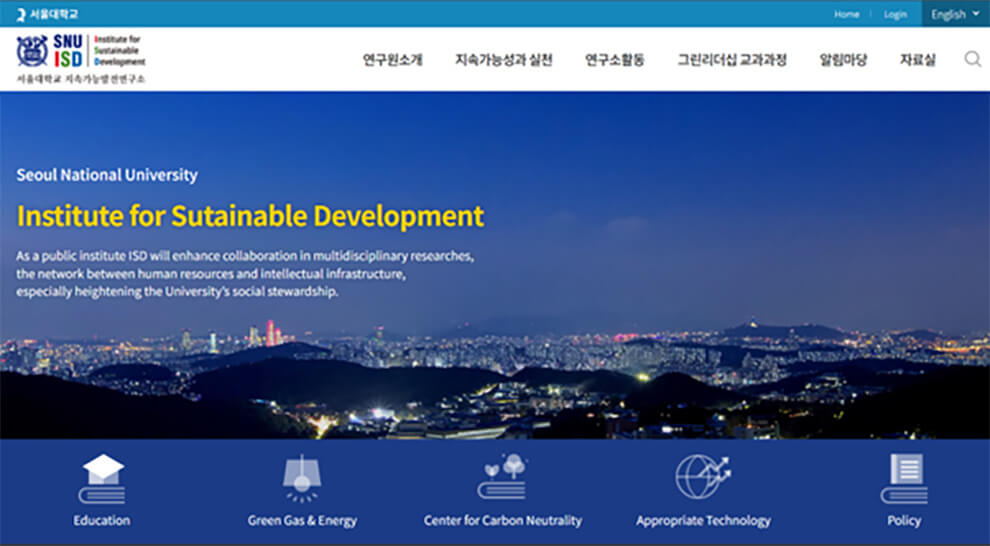
The Seoul National University Institute for Sustainable Development (ISD) was established in February 2009 as a response to the growing global demand for integrated solutions to sustainability challenges. As more than just a research hub, the institute focuses on connecting education, research, and real-life application through its six divisions: the Sustainable Development Education Center, GHG & Energy Management Center, Carbon Neutrality Center, Appropriate Technology Center, Sustainable Development Policy Center, and Sustainable Development Theory Center.
Nurturing Future Leaders at the Center for Sustainability Education
Among the six divisions, the Center for Sustainability Education is responsible for organizing academic programs and opportunities to develop students’ sustainability literacy. It actively collaborates with companies, institutions, and organizations to connect academic insights to real-world challenges.

Keywords for the vision of the Center for Sustainability Education
One of the center’s major programs includes the Green Leadership Certificate Program. Launched in 2011 with the support of the Ministry of Environment, the program is part of SNU’s long-term vision for building a sustainable campus. With approximately 260 students participating every semester, students partake in a combination of academic learning and practical opportunities that can help them advance sustainable development across diverse fields.
An essential aspect of the program is the Green Leadership Internship. This internship is typically offered during summer and winter and consists of a minimum of 90 hours of fieldwork, completed in various fields such as government research institutes, environmental NGOs, private corporations, and international organizations. Key partners include the National Institute of Biological Resources, SK Hynix, Hanwha Energy, and the World Wide Fund for Nature (WWF) Korea. To ensure the program is responsive to changes in the field of sustainability, it continuously seeks new partnerships for students.
Managing Greenhouse Gas Through Carbon Neutrality Projects
Alongside its educational initiatives, SNU has taken proactive steps to institutionalize sustainability through systematic greenhouse gas (GHG) management and energy efficiency efforts. The Greenhouse Gas and Energy Management Center, established in 2012 under ISD, leads these efforts by implementing a campus-wide integrated monitoring system that provides transparent, real-time data on GHG emissions and energy consumption.
The center operates the SNU Carbon Neutrality Portal(https://co2.snu.ac.kr), an online platform that publicly discloses SNU’s emissions data, including building-specific GHG levels, annual emission trends, and real-time energy usage patterns. The platform provides comparative rankings of campus buildings by emission levels and energy use, and also tracks the performance of renewable energy sources such as solar power installations.
The platform plays an important role in ensuring SNU adheres to sustainability standards. According to the Seoul Metropolitan Government’s Energy Data, SNU ranked first among all buildings in Seoul in terms of energy consumption and greenhouse gas (GHG) emissions, recording nearly 150,000 tons of GHG emissions in 2021 alone. Through this monitoring system, the ISD attempts to support the university’s transition toward carbon neutrality and sustainable development.

Map showing building-specific energy use intensity(EUI) levels
To complement this platform, the center also publishes the annual Green Report. This presents an in-depth analysis of the university’s progress in reducing GHG emissions, improving energy efficiency, and advancing sustainable campus development. The most recent report highlights key achievements, including a 20% increase in solar energy capacity with solar panels now installed on 46 buildings. Additionally, a 100 million won investment was made to replace existing lighting with energy-efficient LEDs, which is expected to reduce CO₂ emissions by 295 tons. The report also notes a 13.2% reduction in GHG emissions per unit area, reflecting improved building energy performance, while identifying areas for further improvement.
Through the integration of education and research, SNU aims to introduce new innovations for sustainability. By cultivating sustainability leaders, SNU actively contributes to building a more sustainable, resilient future.
SNU News. S. J.