

The team of Professor Huang Ru-Yang Yuchao from the School of Integrated Circuits/Integrated Circuit High-Precision Innovation Center of Peking University has researched and reported a memristor-based visual neuromorphic computing chip, which uses an optical transistor-memristor (One-phototransistor-one-memristor, 1PT1R) Array implementation, with the integrated sensing, storage and computing function of optical images For on-line training and recognition of light images. The author used an optical transistor as a gating (selector) for a memristor array to construct an optical transistor-memristor array chip with high linear optically adjustable conductivity weights, anti-crosstalk and silicon process compatibility characteristics, which solves the current problem of memristor vision. Nonlinear conductivity weight adjustment of neuromorphic devices Important issues such as poor device consistency, array crosstalk, and insufficient silicon process compatibility.
In addition, the phototransistor-memristor (One-phototransistor-one-memristor, 1PT1 R) array is applied to the visual sense memory integrated computing task, with high-speed optical image online learning and high-precision recognition functions. Related results were published in Advanced Materials under the title “One-phototransistor-one-memristor Array with High-linearity Light-tunable Weight for Optic Neuromorphic Computing”.
Dang Bingjie, a 2020 doctoral student at Peking University School of Integrated Circuits/Integrated Circuit High-Precision Innovation Center, is the first author, and Professor Yang Yuchao and Academician Huang Ru are the corresponding authors.
With the rapid development of IoT technologies, autonomous driving and other intelligent technologies, the number of image sensors used for artificial visual information perception has increased dramatically. Moreover, with the increased pixel density and frame rate requirements of intelligent electronic systems for image sensors, image processing has become a typical data-intensive computing task. Conventional artificial vision systems are often implemented with mature CMOS technology, including image sensors for sensing visual information, memory units for storing visual information, and information processing units for processing complex images. Due to the different functional requirements and fabrication techniques of traditional artificial vision systems, the sensors are physically separated from the computing unit, which results in unstructured and redundant data during data processing of the image sensor nodes. Therefore, image sensor terminals need to obtain a large amount of raw data locally and transmit it to a local computing unit or cloud computing system, which creates serious problems for traditional artificial vision systems in terms of energy consumption, response time, data storage, communication bandwidth, and security.
Memristor-based visual neuromorphic devices can fuse visual information perception, storage, and computing functions, thereby reducing the computational delay and redundant data storage during the image sensor from perception to calculation. However, current visual neuromorphic devices and arrays based on photo-induced memristive effects still face non-ideal characteristics such as non-linear weight updates, poor device consistency, silicon process incompatibility, conductance drift, few distinguishable conductance states, short state hold times, and array crosstalk, which makes it difficult to achieve high precision with current memristor visual neuromorphic devices High-reliability large-scale visual neuromorphic computing hardware integrated array with chip.
In order to solve many non-ideal characteristics and problems faced by existing memristor visual neuromorphic devices and arrays, the team of Professor Huang Ru-Yang Yuchao, Academician of Peking University School of Integrated Circuits/Integrated Circuit High-Precision Innovation Center, used optical transistors as memristors for the first time. Array gating (selector), The crosstalk and integration problems of current visual neuromorphic device arrays were solved, and a visual sensory memory integrated computing hardware system based on an optical transistor-memory resistor array was implemented. Compared to current visual neuromorphic computing devices versus arrays, an integrated array based on an optical transistor-memristor (1PT1 R) has high linear conductivity weight adjustable characteristics, stable conductivity states, a large number of conductivity states (500 levels), low write operation delay (100 μs), and low fluctuation (σLTP = 0.29%, σLTD = 0.22%) ) and other advantages. In addition, the research team built an optical artificial neural network (OANN) using an integrated array of optical transistor-memristor (1PT1R), which can support online accelerated training and recognition tasks of images, achieving an image recognition accuracy of up to 99.3% It provides a feasible solution for «building large-scale visual memory integrated computing chip research based on memristors».
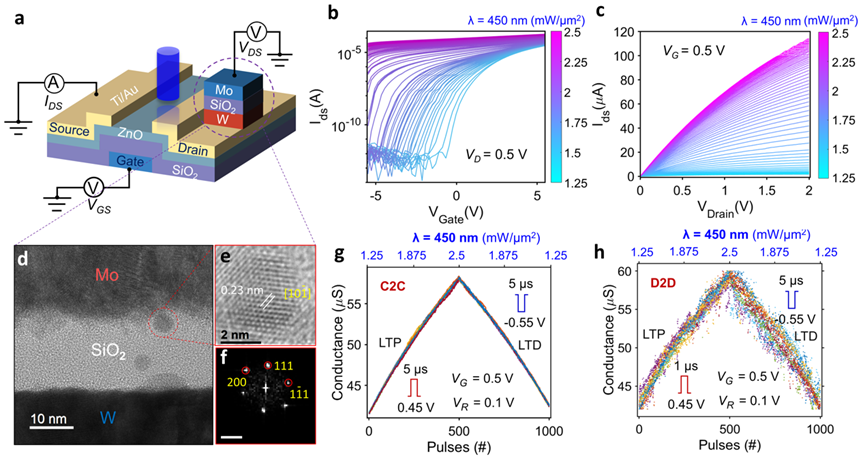
Figure 1. 1PT1 R visual neuromorphic device with high linear conductivity weight adjustable

Figure 2. Visual neuromorphic hardware computing system based on 1 PT1 R array
Related research was published online in Advanced Materials under the title “One-phototransistor-one-memristor Array with High-linearity Light-tunable Weight for Optic Neuromorphic Computing”. Dang Bingjie, a 2020 doctoral student at Peking University School of Integrated Circuits/Integrated Circuit High-Precision Innovation Center, is the first author, and Professor Yang Yuchao and Academician Huang Ru are the corresponding authors.
Academician Huang Ru-Professor Yang Yuchao’s team has long been deeply involved in the research of memristors, brain-like computing, and memory-computing integrated smart chips. So far, it has published more than 130 papers in journals and conferences such as Nature Electronics, Nature Reviews Materials, Nature Nanotechnology, Nature Communications, Science Advances, and IEDM, 2 papers were selected as TOP 0.1% ESI hot papers, and 11 papers were selected as TOP 1% ESI highly cited papers Research work forms an important influence internationally.
The research work is supported by projects such as the National Key Research and Development Program, the National Fund for Distinguished Youth, the National Natural Science Foundation of China’s Post-Moore Major Research Program, the 111 Program, and the Peking University-Baidu Fund, Fok Ying-tung Education Foundation, and Tencent Foundation.
References
Dang, B., Liu, K., Wu, X., Yang, Z., Xu, L., Yang, Y., Huang, R., One-phototransistor-one-memristor Array with High-linearity Light-tunable Weight for Optic Neurological Computing. Adv. Mater. 2022, 2204844.
PEKING UNIVERSITY